Every business owner reaches a point where gut feelings stop being enough. The spreadsheets are overflowing, the team is stretched thin, and somewhere between the data you have and the decisions you need to make, something keeps getting lost.
That is usually the moment people start seriously asking: what would actually help here?
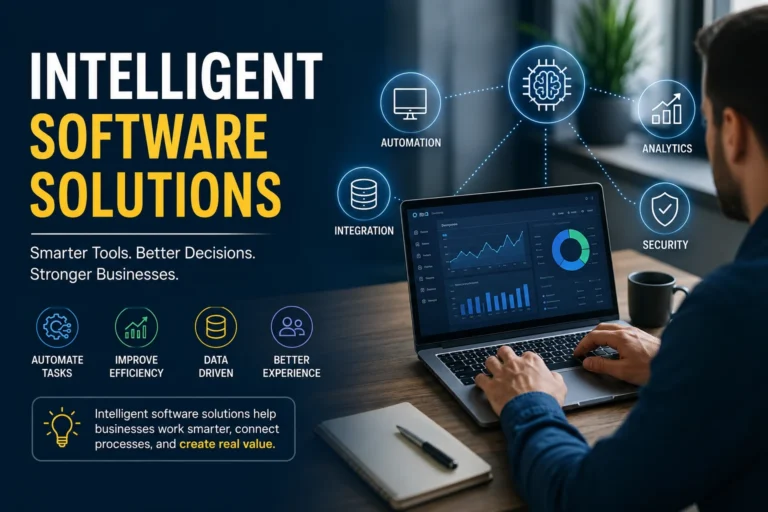
Intelligent software solutions are the answer a lot of businesses land on, and for good reason. But picking one, or even understanding what it really means, can feel overwhelming if you are coming at it fresh.
What “Intelligent” Actually Means in Software
Not every tool with a flashy dashboard qualifies. Intelligent software is not just software that runs fast or looks clean. It refers to systems that can learn from data, adapt behavior based on patterns, and support decisions in ways that go beyond simple if-then rules.
Think of it this way. A basic billing system tells you what happened. An intelligent system can tell you what is likely to happen next, flag anomalies before they become problems, and surface options you might not have thought to look for.
The practical difference is significant. One tool records your history. The other helps you actually use it.
The Businesses That Benefit Most
Here is a real scenario worth considering. A mid-sized e-commerce company was losing customers after their first purchase. The team knew it was happening, but they could not pinpoint why. After implementing an intelligent customer analytics platform, they discovered a pattern: customers who did not receive a follow-up communication within 48 hours of delivery churned at nearly three times the rate.
That is something no manual audit would have found quickly. The software flagged it by processing thousands of orders simultaneously and comparing behavioral segments.
This kind of insight is not exclusive to large enterprises anymore. Intelligent software solutions have become far more accessible, and businesses of almost any size can benefit, especially in operations, customer experience, and financial planning.
What to Look For When Choosing One
This is where people make the most mistakes. They focus on features instead of fit.
A few things that actually matter:
- Integration with existing tools. If it cannot connect to what you already use, you will spend months managing two disconnected systems.
- Learning curve for your team. The most advanced system is useless if no one touches it after month one.
- Transparency in how decisions are made. Particularly for anything in finance or compliance, you need to understand how the system arrives at a recommendation.
- Scalability. Where do you want to be in two years? The software should be able to grow alongside that goal, not require a full replacement.
Do not just trust the sales demo. Ask for a real pilot period with your own data.
Common Mistakes Businesses Make
One of the most common? Buying intelligent software to solve a problem that actually needs a process fix first.
If your team is not consistently entering data, no intelligent system will produce reliable outputs. Garbage in, garbage out. It sounds obvious, but a lot of organizations skip this step and then blame the software when outcomes disappoint.
Another mistake is treating implementation as a one-time event. These systems perform better over time, but only if someone is regularly reviewing outputs, correcting errors, and adjusting configurations. You need a person (or a small team) with ownership over the tool, not just an admin login nobody uses.
What Real Adoption Looks Like
The companies getting the most value out of intelligent software solutions tend to share a few habits.
They start small, often with one team or one use case, and prove value before expanding. They involve end users in setup, not just IT. And they treat the software as a collaborator in their process, not a replacement for thinking.
According to McKinsey’s research on AI adoption, companies that embed intelligent tools into core workflows consistently outperform those that use them only for peripheral tasks. The integration depth matters as much as the tool itself.
There is also a growing body of evidence from MIT Sloan Management Review suggesting that businesses with strong data cultures adopt intelligent software more successfully, largely because the foundation for using insights already exists.
The Practical Takeaway
Intelligent software solutions are not a magic fix. But when the right one is matched to the right problem, with the right team support behind it, they change how a business operates at a fundamental level.
If you are on the fence, the real question is not whether your business is ready for intelligent software. It is whether your business can afford to keep waiting while competitors figure it out first.
Start with a specific pain point. Build from there. The rest tends to follow.